
COMMENTARY
Twenty-Seven and Rising: Why the PDP’s Best Days Lie Ahead


By Borono Bassey
Today, if you mention the name Peoples Democratic Party in a gathering of Nigerians who are old enough to make sense of politics, governance and civics, there is a greater possibility that the crowd in that gathering will break into three camps – those whose memories of the party provoke anger-laden pessimism, those whose hopes for Nigeria still stir a patriotic optimism, and those who would rather perch on the fence with a wary indifference.
Few political organizations anywhere in Africa evoke such a wide spectrum of emotions.
Yet, it is this very polarity that speaks to the PDP’s peculiar place in Nigeria’s national life: it is not a party you can easily ignore, because its story is in many ways the story of our democracy itself.
That story began in defiance. In January 1998, a small group of politicians—first the G7, then the G18, and finally the G34 under Dr. Alex Ekwueme – risked detention and persecution to resist General Abacha’s bid to transmute into a civilian ruler.
Their courage reawakened national consciousness, rallied Nigerians across regions, and eventually birthed a broad-based movement. By August 31st, that same year, the coalition crystallized into the Peoples Democratic Party, with a colourful event at the International Conference Centre, Abuja, a political force literally born from resistance and sacrifice, and destined to become the vessel of Nigeria’s return to democracy.
Now, twenty-seven, the PDP has lived through triumph and turbulence, glory and gaffes, victories and defeats. But what is remarkable is not merely that it has survived; rather, our Party, like the proverbial phoenix, continues to emerge from its own ashes time and again, recalibrating, reforming, and refusing to fade into irrelevance.
Those who know its origin will remember that the PDP was born not in comfort, but rather it was forged in the uncomfortable raging fire of courage. In the tense nights of 1998, as dictatorship darkened the land, men gathered in secret to say no to tyranny.
They were hunted, some jailed, yet their defiance lit the torch that became the umbrella under which millions of Nigerians would eventually stand. That spirit of audacity remains the PDP’s most enduring inheritance.
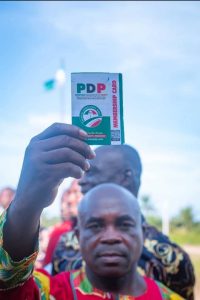
From the euphoria of 1999 when it steered Nigeria back into democracy, to the sixteen years in which it held the reins of government, shaping policy and direction, the PDP imprinted itself on the nation’s institutions. It was under the party’s watch that Nigeria secured the historic debt relief deal, which freed the economy from crippling obligations.
It was during the Peoples Democratic Party’s era that telecommunications were liberalized, birthing the GSM revolution that today connects millions of Nigerians. The party expanded access to education through new universities and polytechnics, revitalized agriculture through initiatives that boosted local food production, and began the ambitious reform of the health sector. Major infrastructure projects, from highways to power sector investments, bore the imprint of PDP stewardship. It also laid down anti-corruption frameworks that successive governments still lean on.
No serious student of Nigeria’s political history can deny that the PDP gave the country its longest stretch of democratic stability.And perhaps it is for this very reason that Nigerians, having once tasted and enjoyed the benefits of those solid pillars the party erected across all sectors of the economy, now find themselves restless – even angry – that the PDP has not yet mustered enough strength to reclaim power at the center and reposition the nation on the path of accelerated growth and progress.
Their anger is not misplaced. For ten years, the other party has held the reins, and every signpost – from a faltering economy to deepening insecurity – suggests that things will only get worse. In the quiet of homes and in the noise of markets, the refrain grows louder: the party that once set Nigeria on a course of renewal must rise again to rescue it from decline.
Now, at twenty-seven, the party stands not as a tired giant but as a tested one. Opposition has stripped it of arrogance and forced it back to humility, reflection, and rebuilding. The anger of its critics, the optimism of its faithful, and the indifference of the undecided are all proof of its continued relevance. And relevance, in politics, is oxygen.
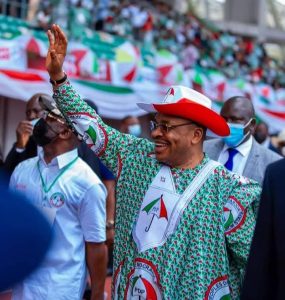
For if Nigeria’s democracy has sometimes stumbled, the PDP has, in a way, also stumbled with it. But what makes its story different is its resilience. Time after time, defections and defeats have been predicted to spell its demise. Yet each time, the PDP has reminded Nigerians that a party born in the crucible of resistance is not so easily erased. Like a phoenix, it has refused to stay buried in ashes; it has chosen instead to stretch its wings toward the skies of tomorrow.
And the skies of tomorrow hold a brighter promise for our Party and the millions of Nigerians who continue to wish for our Party to return as the Party at the center.

The Nigerian population is one that is made up of predominantly young people – its median age is just under 19. This new generation does not carry the same political baggage as their parents. They want jobs, schools, security, and dignity. A PDP that listens, that places youth at the center of policy, that wields digital tools not only for campaigns but for governance, has the chance to connect the courage of 1998 to the aspirations of 2025 and beyond. If the party once dared to defy a dictator, can it not now dare to defy mediocrity?
The PDP’s strength has always been its breadth – its umbrella stretched across every region, faith, and ethnicity. In a nation too often threatened by divisions, that breadth is not just an asset but a lifeline. At the significant age of 27, if our Party- the PDP takes the patriotic step of recommitting itself to inclusivity, if it resists the lure of narrow interests and embraces once more the spirit of its founders, then our Party can return to hold the reins of Power at the center in the next election cycle. Many things point to that possibility.

Twenty-seven years after its birth, the PDP’s story is still unfinished. Its critics may sneer, its rivals may boast, but the truth remains: the party that began as a whisper in Kaduna still echoes across the land. And as long as it remembers that it was born not just to win elections but to defend democracy, it will continue to rise from every fall.
In the end, the PDP at 27 is more than a political party’s anniversary. It is a reminder that from ashes can come a flame of respite, from setbacks can come strength, and from history can come hope. The PDP, as things currently show,is again on a courageous journey of reinventing itself and becoming the Party to reposition Nigeria on the path of accelerated growth and progress. Its past is indelible, its present undeniable, and its future, which is within grasp, is immeasurably bright!

Happy 27th Anniversary to the Peoples Democratic Party!
*Borono Bassey, a former Spokesman for the PDP in Akwa Ibom State, wrote in from Uyo.
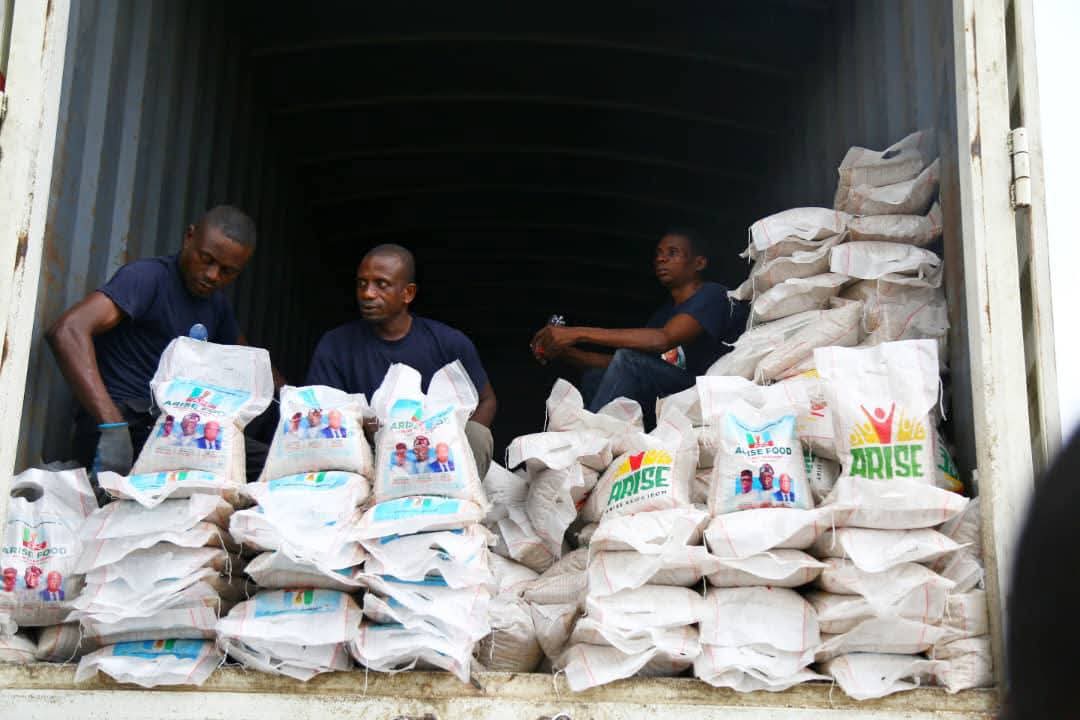
By Lucy Daniel
In a time when many Nigerian families are struggling with rising food prices and economic uncertainty, humanitarian interventions have become more than acts of charity; they have become instruments of social stability. In Akwa Ibom State, one of the most visible examples of this approach is Governor Pastor Umo Bassey Eno’s ARISE Free Food Distribution Programme, a statewide initiative that is gradually redefining the relationship between government and the governed.

Commissioner for Humanitarian Affairs, Rt.Hon. Emem Ibanga making a presentation to one of the beneficiaries recently
With the fourth phase of the programme now reaching 28 out of the 31 Local Government Areas of the state, the intervention has evolved from a relief measure into one of the largest humanitarian food support programmes by any sub-national government in Nigeria.
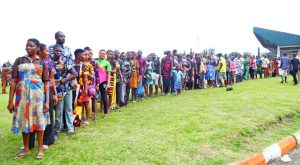
The recent distribution exercises in Ibiono Ibom and Itu Local Government Areas offered a clear picture of the programme’s growing reach and impact. In both local governments, 7,000 bags of rice and beans were distributed to vulnerable households identified through the State Social Register. The atmosphere was not merely one of food distribution but of gratitude, hope and renewed confidence in government.
For many beneficiaries, the intervention came at a critical time.
Mrs. Ekaette Udo, a beneficiary in Itu Local Government Area, described the support as a lifeline for families struggling with the rising cost of living.
”This food will help us reduce the money we would have spent on feeding. We appreciate Governor Umo Eno for this gesture and we pray that God will continue to give him wisdom to lead us,” she said.
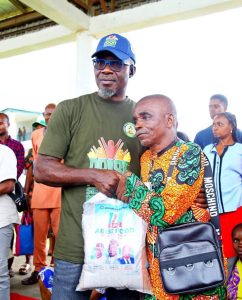
Secretary of the Bulk purchasing Agency, Hon Unyime Etim, presents food item to a beneficiary recently
Another beneficiary, Mr. Inyang Etim, noted that the assistance would significantly support his household expenses.
”The rice and beans will help us at home, especially with the high cost of food. We are happy that Itu is included in this programme,” he remarked.
For elderly beneficiaries like Mrs. Mfonima Akpan, the programme represented more than food assistance. It was a reminder that the government had not forgotten them.
”I am happy today because I did not expect to receive this kind of support. I thank our Governor and everyone who made this possible,” she said.
These testimonies reflect similar stories emerging from the 28 local government areas already covered in the current phase. Across Akwa Ibom, thousands of widows, elderly citizens, persons with disabilities, low-income earners and vulnerable families have benefitted from a programme specifically designed to cushion the effects of economic hardship.
What makes the ARISE Free Food Distribution Programme particularly significant is its systematic approach. Rather than relying on political patronage, beneficiaries are drawn from the State Social Register, ensuring that assistance reaches those who genuinely need it. This has strengthened transparency, reduced allegations of bias and enhanced public confidence in the process.
The programme’s impact extends beyond individual households. Economic experts often argue that food security interventions can influence market behaviour by reducing excessive demand pressures. This observation was echoed by the Senior Special Assistant to the Governor on Market Matters, Akparawa Idorenyin Raphael, who noted that when thousands of families receive staple food items free of charge, the immediate pressure on the market is reduced, helping to moderate food prices.

Akparawa Idorenyin Raphael donating food item to one of the beneficiaries in Ibiono Ibom local government area recently
The progressive expansion of the programme further demonstrates government responsiveness. From an initial distribution of 3,000 bags, the intervention grew to 4,000 bags and now stands at 7,000 bags per local government in the fourth phase. Such growth reflects both increased government commitment and an understanding of the realities confronting ordinary citizens.
Yet the food programme is only one component of a broader humanitarian architecture under the ARISE Agenda. Alongside food distribution, the administration has implemented social welfare initiatives, enterprise support programmes, healthcare interventions, educational assistance and economic empowerment schemes targeted at vulnerable populations.
The recently announced N31 billion economic empowerment programme, allocating N1 billion to each of the 31 local government areas, further demonstrates a shift from relief to sustainable economic empowerment. While food support addresses immediate needs, enterprise funding aims to help citizens create wealth, expand businesses and improve their livelihoods.
This combination of compassion and economic empowerment offers an important lesson in governance. Effective leadership is not measured solely by the number of roads constructed or buildings commissioned. It is equally measured by the ability to protect vulnerable citizens during difficult times while creating opportunities for long-term prosperity.
There are valuable lessons here for other states and even for national policymakers.
First, humanitarian programmes are most effective when they are institutionalized and data-driven. The use of the Social Register has improved targeting and accountability.
Second, social interventions work best when combined with broader economic development initiatives. Relief without empowerment creates dependency, while empowerment without relief may leave vulnerable populations behind.
Third, governance becomes more meaningful when citizens can directly feel the impact of public policy in their daily lives. For many families across Akwa Ibom, the ARISE Free Food Distribution Programme has transformed government from an abstract institution into a caring presence.
The intervention also reflects the broader philosophy of the ARISE Agenda, which places people at the centre of development. While major infrastructure projects continue across the state, including roads, healthcare facilities, schools, housing schemes and agricultural investments, the administration has maintained a deliberate focus on social protection.
As Akwa Ibom approaches the 2027 electoral cycle, many observers will inevitably assess Governor Umo Eno’s performance. Such assessments should be based not only on campaign promises but also on measurable outcomes. The evidence so far suggests a government that has invested simultaneously in infrastructure, economic growth and human welfare.
The sustained implementation of the ARISE Free Food Distribution Programme across 28 local government areas demonstrates consistency, commitment and administrative capacity. More importantly, it demonstrates empathy, a quality often missing in public leadership.

For many beneficiaries, the programme is not merely about bags of rice and beans. It is about dignity, inclusion and hope. It is about knowing that the government recognizes their struggles and is prepared to respond.
As the fourth phase nears completion across all 31 local government areas, the programme stands as one of the clearest examples of people-centred governance in contemporary Nigeria. It has provided immediate relief, strengthened social cohesion, stimulated local economic stability and reinforced public trust.
Ultimately, the strongest argument for granting Pastor Umo Bassey Eno, PhD, a second term may not lie in political rhetoric but in the lived experiences of ordinary citizens whose lives have been positively touched by his administration’s policies. From the elderly woman receiving food support in Itu to the struggling family in Ibiono Ibom finding temporary relief from rising food costs, the testimonies speak for themselves.
In governance, results matter. In humanitarian leadership, compassion matters. The ARISE Free Food Distribution Programme has shown that under Governor Umo Eno, both can work together to improve lives and build a more inclusive society.
#UmoEno So far, So good#AriseAgenda
#ARISEFreeFoodDistribution
#PeopleCentredGovernance
#HumanitarianLeadership
#FoodSecurity#AkwaIbomRising
#PastorUmoEno#ARISEAgendaWorks
Daniel, SA to the Governor on Media
Writes from Uyo, Akwa Ibom State
providencemaga@yahoo.com
By Lucy Daniel
A state does not become remarkable simply because it builds impressive projects. It becomes remarkable when those projects begin to change lives, reshape opportunities and create a story that others can see, understand and learn from.
That is the emerging story of Akwa Ibom under Governor Umo Eno and the ARISE Agenda.
At first glance, the ARISE Agenda may appear to be a familiar government development framework. But beyond the acronym lies a broader idea: that development must connect infrastructure with people, economic opportunity with inclusion, and government investment with a better quality of life.
This is increasingly becoming visible across Akwa Ibom.
From roads and aviation infrastructure to healthcare, agriculture, housing, education, skills development and technology, the State is gradually building an interconnected development ecosystem. More importantly, the story is beginning to travel beyond the borders of Akwa Ibom.
And that matters.
In today’s competitive world, states and cities are no longer judged only by what they possess. They are judged by how effectively they use what they have to create opportunities.
Akwa Ibom has enormous advantages, its location, agricultural potential, natural resources, tourism assets, human capital and relatively strong infrastructure base. But advantages do not automatically translate into prosperity. They must be connected by vision, investment and effective governance.
That is where the ARISE Agenda seeks to make a difference.
Beyond Projects, Building Connections
Perhaps the most important feature of the emerging development story is the connection between projects.
Consider the Victor Attah International Airport.
An airport is never just a terminal building. When properly integrated into the economy, it becomes a gateway for tourism, commerce, investment, business travel and human mobility.
The growing international orientation of the airport therefore has implications far beyond aviation. It can help connect Akwa Ibom businesses to wider markets, make the State more accessible to investors and strengthen its position as a destination for tourism and conferences.
The same logic applies to roads.
A road linking rural communities to urban centres is not simply infrastructure. It can shorten the distance between farmers and markets, reduce transportation costs and stimulate economic activity.
Healthcare infrastructure tells another story.
A modern hospital is not merely a building filled with equipment. It is an investment in human dignity, productivity and confidence. When citizens can access quality healthcare closer to home, families are protected from avoidable economic hardship and communities become more productive.
Agriculture, too, becomes more powerful when viewed as an economic chain rather than simply food production.
Seedlings, farmers, processing, transportation, markets and technology must work together.
That is the deeper meaning of an interconnected development agenda.
The Human Face of Development
Yet there is a danger in development communication.
Governments can become so focused on announcing projects that they forget the people behind the statistics.
The true story of development is not found in the ribbon-cutting ceremony. It is found in what happens afterwards.
It is the farmer who can now move produce more easily.
It is the young person who acquires a skill and discovers a new source of income.
It is the mother who can access healthcare without travelling hundreds of kilometres.
It is the entrepreneur who finds that better infrastructure makes it possible to expand a business.
It is the family that moves into decent housing.
These are the stories that give the ARISE Agenda its human meaning.
And these are also the stories that can travel beyond Akwa Ibom.
From Local Development to Global Visibility
The world is increasingly connected. A project in Uyo can become a subject of discussion in Lagos, Abuja, Accra, London or Dubai within hours.
But visibility alone is not enough.
The global audience is becoming more sophisticated. Investors want data. Development experts want measurable outcomes. Citizens want evidence. International media want stories that can be independently understood.
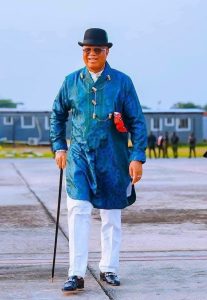
Governor Umo Eno of Akwa Ibom State
Therefore, Akwa Ibom’s communication strategy must continue evolving.
The State should not only tell people what has been built. It should increasingly demonstrate what those investments are producing.
How many businesses are benefiting?
How many jobs are being created?
How much travel time has been reduced?
How many farmers have gained access to markets?
How many young people have acquired employable skills?
How much investment is being attracted?
What is the measurable improvement in healthcare and education?
These questions do not diminish government achievements. They strengthen them.
Because the strongest advertisement for development is evidence.
A Nigerian Lesson
There is also a bigger national lesson.
Nigeria’s development cannot depend entirely on federal initiatives. States are critical laboratories where innovative ideas can be tested and adapted to local realities.
If Akwa Ibom succeeds in connecting infrastructure, agriculture, healthcare, human capital, technology and investment, other states should be able to study those experiences and adapt what works to their own circumstances.
That is how local development becomes national knowledge.
Akwa Ibom does not need to claim perfection. No government has it.
What matters is the willingness to build, measure, correct, improve and communicate honestly.
That is what transforms an administration’s programme into a development model.
The Question of Legacy
For Governor Umo Eno, the most important question will eventually be one of legacy.
Will the ARISE Agenda remain identified primarily with one administration, or will it become embedded in institutions, infrastructure, economic systems and public expectations?
The latter would be the greater achievement.
A truly successful development agenda should outlive political personalities. It should leave behind systems that continue to create opportunities even when the political actors have moved on.
That is why institutionalisation is as important as commissioning.
Buildings can be inaugurated. Roads can be commissioned. Programmes can be launched.
But institutions and economic systems are what sustain development.
Taking the Story Beyond Akwa Ibom
Akwa Ibom is therefore at an interesting point in its development journey.
The State is not simply trying to improve itself. It is increasingly positioning itself to be seen, connected and understood beyond its geographical boundaries.
The challenge is to ensure that the story remains bigger than political promotion.
Let citizens tell it.
Let entrepreneurs tell it.
Let farmers tell it.
Let investors tell it.
Let independent observers examine it.
Let the numbers speak.
When development is real, the people eventually become its most credible communicators.
The ARISE Agenda has the opportunity to become more than a state development programme. It can become a case study in how a sub national government connects physical infrastructure with human development and economic ambition.
But that opportunity comes with responsibility.
Akwa Ibom must continue building, measuring, communicating and improving.
Because the ultimate destination is not applause.
It is impact.
And when that impact becomes visible enough to be experienced by citizens, recognised by businesses and understood beyond the State, the development story of Akwa Ibom will no longer belong only to Akwa Ibom.
It will become part of Nigeria’s larger story of what is possible when vision is matched with purposeful action.
#UmoEno #AriseAgenda #AkwaIbom #GoodGovernance #Development #Investment #Infrastructure #HumanCapital #Nigeria
Daniel, SA to the Governor on Media
Writes from Uyo, Akwa Ibom State
providencemaga@yahoo.com
COMMENTARY
The Power of Partnership: How Collaboration Is Expanding Humanitarian Impact in Akwa Ibom
By Ekaette Okon Joseph
In Akwa Ibom State, Governor Umo Eno’s administration is expanding humanitarian support through a partnership model that pairs government coordination with outside expertise, funding and technology.
According to Commissioner for Humanitarian Affairs Princess Emem Ibanga, FCIPA, the model brings together faith-based organisations, development partners and the private sector to reach Persons with Disabilities, women, youth and other vulnerable groups across the state’s local government areas.
One example is the Fourth Thursday Assistive Mobility Clinic. Persons with Disabilities who are unable to walk undergo clinical assessments to ensure that every mobility aid provided matches their physical condition and mobility requirements. The clinic is provided free of charge, and beneficiaries make no payment at any stage.
Ibanga said the monthly outreach is fully funded by Governor Umo Eno, PhD, as part of his administration’s commitment to inclusion and dignity for Persons with Disabilities.
Skilled technicians trained through the Assistive Mobility Device Coupling Training, facilitated by The Church of Jesus Christ of Latter-day Saints in partnership with the state government, assemble, customise and adjust each wheelchair and walking aid to suit individual beneficiaries.
A total of 444 Persons with Disabilities have received wheelchairs and mobility devices through the partnership, following the donation of 263 wheelchairs and 181 walking aid devices by The Church of Jesus Christ of Latter-day Saints, Ibanga said. She said the donation reflects the Church’s commitment to supporting vulnerable groups through humanitarian service.
Ibanga said Governor Eno personally facilitated clearance of the consignments so the equipment could reach beneficiaries without delay.
According to Ibanga, physiotherapists from Uganda were engaged to train participants in international best practices in assistive device assembly and adaptation. She said the training gave younger participants a career path in rehabilitation services, a field still growing in Nigeria.
Ibanga coordinates these partnerships as Commissioner for Humanitarian Affairs. She said the Ministry works to align the interests of development partners, faith-based organisations, corporate institutions and government agencies around the ARISE Agenda vision of Governor Umo Eno.
That coordinating role was on display recently when Jobberman Nigeria’s leadership visited Ibanga at her office.
“I welcomed the delegation led by its Country Head of Programmes, Mr. Olamide Adeyeye, on a courtesy visit to our Ministry,” Ibanga said. “Our engagement focused on building stronger partnerships that will improve livelihoods and create more opportunities for vulnerable groups across the State.”
Ibanga said the discussion covered five priorities: expanding youth employment and employability programmes, supporting skills development and economic empowerment for young people, promoting inclusive opportunities for Persons with Disabilities, exploring Jobberman’s participation in the forthcoming Humanitarian Day and Humanitarian Roundtable, and aligning future programmes with the state’s humanitarian priorities.
She commended Jobberman Nigeria’s youth development work and acknowledged its grassroots impact in Akwa Ibom State since 2023, when the organisation began operating in the state.
“As a government, we recognise that meaningful and lasting development is achieved through collaboration,” Ibanga said. “We look forward to working more closely with Jobberman Nigeria to expand opportunities for our young people, strengthen livelihoods and improve the wellbeing of vulnerable citizens in line with the ARISE Agenda of His Excellency, Pastor Umo Eno, PhD.”
Ibanga said the state’s ARISE Free Food Security Programme also continues to support vulnerable households, part of what she described as a wider effort under the ARISE Agenda to treat humanitarian assistance as an ongoing system of support rather than one-off relief.
Ibanga said the Ministry is inviting corporate organisations, development partners and faith-based institutions to join the state’s humanitarian coalition and expand opportunities for vulnerable citizens across Akwa Ibom.


Media Today Nigeria: A Fast-Growing Voice in Nigeria’s Digital News Space

Nigerians urged to take advantage of new China market-access opportunity

TWO SUSPECTED ARMED ROBBERS LINKED TO MURDER AND KIDNAPPING IN ETINAN IN POLICE NET

NYSC Batch B Stream II Orientation Camp opens August 28

2026 AKWA IBOM SPORTS FESTIVAL: GOVERNOR UMO ENO’S BOLD STEP AT DISCOVERING TOMORROW’S SPORTS STARS TODAY

Akwa Ibom Police Command Reels Out Emergency Numbers to the Public
-
NEWS2 years ago
NYSC Batch B Stream II Orientation Camp opens August 28
-
SPORTS1 month ago
2026 AKWA IBOM SPORTS FESTIVAL: GOVERNOR UMO ENO’S BOLD STEP AT DISCOVERING TOMORROW’S SPORTS STARS TODAY
-
Crime12 months ago
Akwa Ibom Police Command Reels Out Emergency Numbers to the Public
-
 SPORTS1 year ago
A’IBOM SPORTS FESTIVAL KICKS OFF SEPTEMBER 8
-
Crime3 weeks ago
TWO SUSPECTED ARMED ROBBERS LINKED TO MURDER AND KIDNAPPING IN ETINAN IN POLICE NET
-
BUSINESS2 weeks ago
Nigerians urged to take advantage of new China market-access opportunity
-
 Tech1 week ago
Media Today Nigeria: A Fast-Growing Voice in Nigeria’s Digital News Space
-
 METRO4 weeks ago
AKWA IBOM STATE POLICE COMMAND DECORATES TWO NEW ASSISTANT COMMISSIONERS OF POLICE, CONDUCTS HEPATITIS SCREENING FOR PERSONNEL